
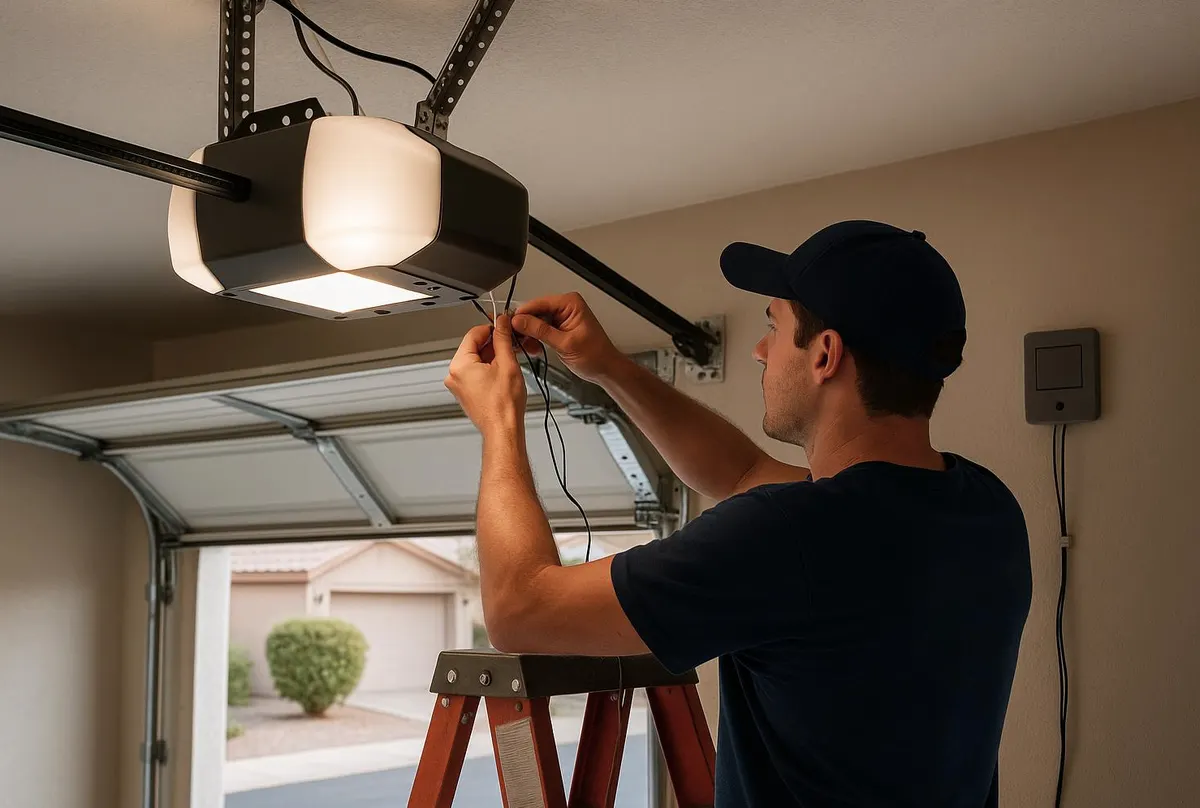
What the Technician Sees First
A typical call starts the same way: someone noticed a frayed wire near the bottom of the door months ago, figured it was cosmetic, and kept using the door. Then one morning the door comes down crooked, or it slams the last foot instead of settling, or there's a loud bang and now the door won't move at all. By the time a technician gets out to look, the cable has usually slipped off the drum or snapped outright, and there's often a worn or cracked roller nearby that's been quietly making the problem worse for weeks.
This is the pattern worth knowing about before it becomes an argument in your own driveway: one of you says "it's just a little fraying, it's fine," and the other says "that thing is going to come down on the car." Here's the plain-language version of who's right.
Cables: The Part Doing the Heavy Lifting
Garage door cables work together with the springs to control the weight of the door as it goes up and down. The springs do most of the lifting force, but the cables are what actually connect the door to that system and keep it moving evenly on both sides. When a cable frays, it's losing individual strands of wire one at a time, usually near the bottom bracket or where it wraps around the drum at the top.
What causes fraying in this area specifically: humidity and heavy rain lead to rust forming on the cable strands, which weakens them from the inside out, not just the surface. Coastal storms and the general damp air common here accelerate that process compared to drier climates. A cable that looks a little rusty and rough isn't just ugly, it's thinner and weaker than it was last year.
A frayed cable doesn't always fail gradually. Often it holds for a long time and then lets go all at once, usually under load, which means the door can drop suddenly, come down unevenly, or pull hard to one side. That's the scenario people are picturing when they say "it's going to come down on the car," and they're not wrong to worry about it.
Rollers: The Part Nobody Looks At
Rollers are the small wheels that guide the door along the track. Nobody thinks about them until they stop working smoothly. Warning signs include grinding or squeaking as the door moves, visible wobble in the roller itself, cracks in a nylon roller, or a door that jerks instead of gliding.
Rollers wear out from simple mileage, but they wear out faster here because of the swing between humid summers and icy winters. Materials expand and contract, grit and road salt get tracked into the garage, and older housing stock in the area often has tracks that were installed years ago and have picked up rust or minor misalignment over time. A worn roller forces the door to work harder to move along the track, which adds strain to everything else in the system.
Why These Two Failures Are Connected
This is the part that settles the argument. A worn roller doesn't just make noise, it makes the door bind slightly as it travels. That binding puts uneven tension on the cables, which accelerates fraying at exactly the spots where the cable already takes the most stress: the drum and the bottom bracket. So the "small" roller problem and the "small" cable problem are often the same problem at two different stages. Ignore the roller long enough, and you speed up the cable failure. Replace the roller and ignore the cable, and you've fixed the symptom but not the wire that's already thinning out.
What to Check Safely (and What Not to Touch)
You can do a visual check without any risk:
- Look at the cables near the bottom corners of the door and where they wrap around the drums near the springs. Watch for individual wire strands sticking out, rust buildup, or visible kinks.
- Check each roller by hand with the door closed and the opener disconnected. Look for cracks, flat spots, or a roller that wobbles loosely in its bracket.
- Listen during a normal open-and-close cycle for grinding, popping, or a scraping sound that wasn't there before.
What you should not do is try to replace the cables yourself. They're under the same kind of tension as the springs, and a cable under load that slips or snaps during a DIY repair can cause real injury. Roller replacement is a bit more forgiving but still involves working close to a door that weighs more than it looks like it does.
When to Call Virginia Beach Garage Door Service
If you've spotted fraying, rust, or a roller that's cracked or wobbling, it's worth getting it looked at before it turns into a door that won't open or a cable that fails mid-cycle. Our Garage Door Repair visits include checking the full cable and roller system, not just the part that's making noise, since the two usually wear out together. For homes where everything still looks fine but the door is a few years into regular use through our humid summers and icy winters, Preventive Maintenance catches fraying and roller wear early, while it's still a simple fix instead of an emergency one.
If you're in Virginia Beach, Norfolk, Chesapeake, Hampton, Newport News, Suffolk, Portsmouth, or Williamsburg and you've got a cable or roller that's got you second-guessing your garage door, call Virginia Beach Garage Door Service and we'll take a look before it becomes the loud failure instead of the quiet one.